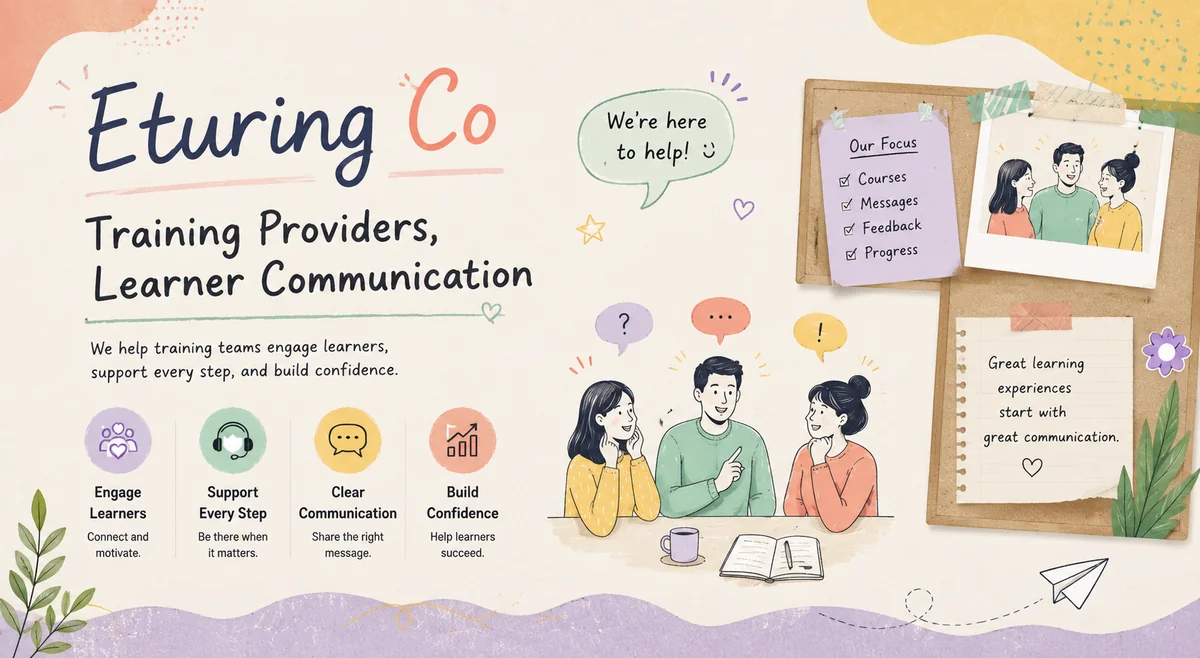
Short courses leave little room for communication problems. If a learner misses joining information, misunderstands preparation requirements or does not know where to raise a question, a meaningful part of the programme may pass before the issue is corrected. A learner communication plan prevents important messages from depending on individual staff memory. It does not need to be elaborate. For a short course, the strongest plan is a concise sequence that identifies what learners need to know, when they need it and who is responsible for making sure the information reaches them.
Map communication against the course journey
Start with the learner's timeline rather than the provider's departments. Trace the experience from confirmation through preparation, the first session, ongoing participation and completion. At each stage, identify information that affects what the learner needs to understand or do.
This separates essential communication from internal activity that does not need to reach the learner. It also exposes gaps where one team assumes another has sent an important message. A simple timeline can therefore provide more control than a large collection of disconnected email templates.
Confirm the learner's next step immediately
Once a learner has secured a place or completed the relevant joining stage, acknowledge what has happened and explain what follows. If another action remains outstanding, make it visible.
A confirmation message should not try to contain the whole course handbook. Its job is to remove uncertainty and give the learner confidence that the process is moving. More detailed information can arrive at the stage where it becomes useful.
Make joining information a dependable reference
Before delivery begins, learners need a clear source for practical arrangements. Depending on the course, this may include location or access information, timing, preparation and the main route for questions.
Avoid spreading essential instructions across several messages unless there is a clear reason. If detailed information is maintained on a platform or course page, tell learners which source should be treated as current. They should not have to compare old emails to determine which instruction still applies.
Use reminders for actions, not noise
A well-timed reminder can be valuable close to a session or deadline, particularly when the learner needs to prepare or bring something. Repetition without purpose, however, can make important messages easier to ignore.
Build reminders around specific learner actions. Keep them concise and consistent with the original information. If arrangements have changed, state the change explicitly instead of sending a revised block of text and expecting learners to notice what is different.
Create one obvious route for questions
Learners should know where to ask for help. A course can become frustrating when administrative questions go to tutors, technical issues go to a general mailbox and nobody is sure who owns the reply.
Provide a main contact route and define the internal escalation behind it. Staff can then direct specialist questions appropriately without making the learner understand the provider's organisational structure. The experience should feel joined up even when several colleagues contribute to the answer.
Prepare communication for delivery changes
Short courses can still encounter venue, timetable, staffing or technology disruption. Decide before delivery who confirms a change, who sends the message and which channel is used when timing matters.
Lead with the practical consequence for the learner. State what they should do and distinguish confirmed information from anything still being assessed. If another update will follow, make that clear so learners are not left contacting staff individually for information that is not yet available.
Close the communication journey properly
The final session is not always the final administrative step. Learners may need information about outstanding work, feedback, completion processes or where to direct a later question.
A concise closing message gives the programme a clear endpoint and prevents uncertainty from drifting into individual inboxes. Where appropriate, it can also explain how the learner can remain connected to the provider or explore relevant further learning without turning the message into an unrelated sales campaign.
Improve the plan after each delivery
Review the questions learners asked and the points where staff had to send corrective information. Those events show where the communication sequence was late, unclear or incomplete. Update the plan before the next cohort while the experience is still familiar.
The plan itself can remain simple: stage, message purpose, owner, channel and any action required from the learner. Automation may help deliver repeatable messages, but it should support a sequence that already makes sense. For a short course, effective communication is measured by how little unnecessary uncertainty it creates. Learners know where they need to be, what they need to do and whom to contact, while staff have a dependable structure that does not compete with the teaching work the course exists to deliver.